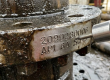
For CNC shop managers and tool manufacturers, the solution to marking Tungsten Carbide and Hardened Steel is clear: Laser technology is the only way to ensure UDI compliance without causing tool failure. To get the best results, we recommend three specific systems:
1. The HS-FL10 Fiber Laser for standard tool shanks, 2. The HS-FL60M MOPA Laser for heat-sensitive aerospace tools, and 3. The HS-FL30-R for cylindrical drill bits. Unlike mechanical stamping or dot peening, these lasers prevent microscopic cracks and maintain tool balance, ensuring your high-value cutting tools remain structurally sound.

The Pitfall Guide: Why Mechanical Marking Kills Carbide Tools
If you are currently using mechanical stamping, engraving, or deep dot peening on your cutting tools, you are sitting on a ticking time bomb. In the high-precision world of machining, these “old school” methods are dangerous for several reasons:
The Danger of Micro-Cracks
Hardened steel and Tungsten Carbide are extremely brittle. When a mechanical pin or stamp strikes the surface, it creates micro-cracks. Under the intense heat and vibration of a CNC spindle (often exceeding 15,000 RPM), these tiny fractures expand. The result? A shattered end mill mid-cut, a ruined workpiece, and potential damage to your expensive spindle.
Destruction of Tool Balance
High-speed cutting tools depend on perfect dynamic balance. Mechanical marking physically displaces metal, creating “valleys” and “peaks” that throw off the tool’s weight distribution. This leads to “chatter,” poor surface finishes, and premature tool wear.
Wear and Tear on Equipment
Carbide is often harder than the pins used in dot peen machines. Attempting to mark a 65 HRC tool with a mechanical pin will lead to rapid tool-head wear and frequent, costly replacements.
Marking hardened tool steel requires precision to ensure the structural integrity of the metal is never compromised. For high-value assets used in die casting and injection, relying on dedicated mold marking and engraving machines guarantees that your traceability codes are deeply etched without introducing micro-cracks that could lead to premature wear.
The Science of the “Cold Mark”: Why Fiber Lasers Reign Supreme
Fiber laser technology (1064nm) is the industry standard for hard metals because it interacts with the material at a molecular level rather than a mechanical one.
- Annealing for Hardened Steel: The laser heats the surface just enough to induce a chemical change (oxidation), creating a jet-black mark. The surface remains perfectly smooth to the touch, meaning zero impact on the tool’s aerodynamics or structural strength.
- Precision Etching for Carbide: Because Tungsten Carbide has a massive melting point, the fiber laser creates a shallow, high-contrast mark that is only microns deep—far too shallow to trigger the structural failures caused by heavy mechanical stamping.
Best Machine #1: The CNC Shop Workhorse (HS-FL10)
Best for: High-speed branding on tool shanks and standard HSS tools.
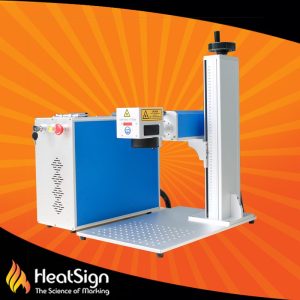
The HeatSign HS-FL10 Fiber Laser (20W/30W) is designed for the high-duty cycle of a tool production floor.
- High Contrast: Produces bright white or deep black marks that stay legible even after being coated in industrial coolants or oils.
- Speed: Mark a logo, serial number, and DataMatrix code on a tool shank in under 3 seconds.
- Durability: With a laser source rated for 100,000 hours, it requires zero consumables—no pins to replace, no ink to refill.
Price Range:$2000 ~ $5500
Best Machine #2: The Aerospace Specialist (MOPA HS-FL60M)
Best for: Ultra-sensitive carbide alloys, medical tools, and aerospace components.
In aerospace manufacturing, “standard” isn’t good enough. You need the HS-FL60M MOPA Fiber Laser to manage heat with extreme precision.
The MOPA Difference: Pulse Control
- Unlike standard lasers, MOPA allows you to adjust the pulse width.
- Minimal Heat Affected Zone (HAZ): By using shorter pulses, you mark the tool with virtually zero heat transfer to the core. This is critical for maintaining the specific hardness and tempering of specialized tool alloys.
- Preserving Coatings: If your tools use TiAlN or AlTiN coatings, the MOPA laser can mark the surface without stripping the protective layer, keeping the tool’s heat resistance intact.

Price Range:$4300 ~ $5300
Best Machine #3: The Geometry Expert (HS-FL30-R)
Best for: Drill bits, taps, reamers, and cylindrical tools.
Marking a flat logo on a round drill bit causes distortion and focus issues at the edges. The HS-FL30-R with Integrated Rotary Axis is the dedicated solution for cylindrical tools.
- 360-Degree Marking: The tool rotates in sync with the laser, allowing for scales, long text, or logos to wrap perfectly around the circumference.
- Perfect DataMatrix Codes: For UDI (Unique Device Identification), the squareness of the code is vital for scan rates. The rotary axis ensures the code is never “stretched,” ensuring 100% readability.
- Versatility: The rotary chuck can be adjusted in seconds to accommodate anything from a 2mm micro-drill to a 50mm heavy-duty boring bar.

Price Range:$2950 ~ $4500
Decision Guide: Which Machine Fits Your Production Line?
Choosing a marking system for hardened materials isn’t just about “burning a logo”; it’s about managing the Heat Affected Zone (HAZ) and the geometry of the tool. Use the table and guide below to find your specific scenario.
The CNC Shop Selection Matrix
If Your Primary Goal is… | Best Material Match | Recommended Machine | The “Why” Behind the Choice |
High-Volume Branding | Hardened Steel, HSS, Iron | Lowest cost per mark. Best for flat tool shanks where speed is the priority. | |
Zero-Risk Aerospace/Medical | Tungsten Carbide, Cobalt | Total control over pulse width. Eliminates micro-cracks on brittle, high-value alloys. | |
Marking Round Drill Bits | Drills, Taps, Reamers | Prevents text distortion. The only way to get a 360° wrap on cylindrical tools. |
Which One Should You Buy? A Reader’s Perspective
Scenario A: “I need a reliable workhorse for my job shop.”
If you are marking standard tool shanks, collets, or hardened steel blocks and your main concern is ROI, go with the HS-FL10 Fiber Laser.
The Logic: You don’t need the complexity of MOPA for standard HSS. This machine is air-cooled, fits on a benchtop, and will run 24/7 with zero maintenance. It’s the fastest path to professional branding.
Scenario B: “I manufacture $500+ aerospace or medical cutting tools.”
If the cost of a single tool failure is higher than the monthly lease of the machine, you need the HS-FL60M MOPA.
The Logic: Brittle carbide is unforgiving. A standard laser can sometimes be too “aggressive” with its heat. The MOPA allows you to “soften” the hit, creating a high-contrast mark without the thermal shock that leads to snapping. This is your insurance policy against tool breakage.
Scenario C: “I specialize in round tools like drills and end mills.”
If your daily workflow involves marking around the circumference of a drill bit, do not buy a flatbed-only laser. You need the HS-FL30-R with a Rotary Axis.
The Logic: Marking a round surface without a rotary leads to “fading” at the edges as the surface curves away from the laser’s focus. The HS-FL30-R keeps the beam perfectly perpendicular to the surface at all times, ensuring your DataMatrix codes are 100% scannable.
ROI Analysis: The “Cost of Failure” Calculation
Many CNC shop managers hesitate at the initial price of a laser. However, let’s look at the Real Cost of Ownership compared to mechanical methods.
The Hidden Costs of Mechanical Marking
- Scrap Rate: If mechanical stamping causes even 1% of your $200 carbide tools to fail, you are losing $2,000 for every 1,000 tools produced.
- Consumables: Dot peen pins for hardened steel cost $50–$100 and dull quickly. Laser consumables cost $0.
- Liability: A shattered tool in a customer’s $500,000 CNC machine can end a business relationship. Laser annealing removes this liability.
- The Verdict: Most HeatSign customers in the tool industry see a full ROI (Return on Investment) in 6 to 10 months through a combination of zero consumable costs and significantly lower scrap rates.

Conclusion: Future-Proofing Your Machining Operations
In an era of smart manufacturing and total traceability, “good enough” marking is no longer acceptable. Using outdated mechanical methods on hardened steel and Tungsten Carbide is a risk to your tools, your machines, and your reputation.
By switching to Laser Annealing and Rotary Precision, you eliminate the threat of micro-cracks and ensure that every tool leaving your shop is a masterpiece of precision and reliability.
FAQs
Will laser marking make my drill bits rust?
No, provided you use the Annealing process. Annealing creates a dark mark without removing the metal’s protective surface, preserving its corrosion resistance.
Is Tungsten Carbide too hard for these lasers?
Not at all. Fiber lasers are specifically tuned to be absorbed by hard metals. Even at low power (20W), they can produce high-contrast marks on any carbide grade.
Can I mark on the flutes of a drill bit?
Never mark on the cutting flutes. We always recommend marking on the shank of the tool. Marking on the flutes will compromise the cutting geometry and the tool’s strength.
How small can a DataMatrix code be?
We can mark clear, scannable codes as small as 1.0mm x 1.0mm, making them ideal for even micro-cutting tools.
What maintenance is required?
These are air-cooled, solid-state systems. There are no lamps or pins to change. Simply keep the lens free of shop dust.
Can the laser mark through coatings like TiAlN?
Yes. The laser can mark directly on the coating or, with the right settings, “anneal” the metal through the coating without damaging the bond.
Is the mark permanent?
Yes. Unlike ink or stickers, laser marks on hardened steel are permanent and resistant to heat, coolants, and heavy wear.
Do I need a special room for the laser?
We offer Class 1 (fully enclosed) systems that can be placed directly on the shop floor next to your CNC machines without needing a special enclosure for safety.