Many DoD suppliers think MIL-STD-130 forces them to mark every part directly. Others think one UID label covers everything. The standard allows both. Section 4.1 says the mark can go on a label, plate, band or tag, or straight onto the part, and the design activity picks the method on the drawing.
What decides it is one rule in section 4.3: the mark must last as long as the part and survive the part’s own tests, cleaning and final paint.
At HeatSign we mark sample parts for suppliers working through this choice. This guide shows when a label is enough, when to mark the part, which method fits which material, how big the Data Matrix code must be, and how it is checked.
- 1
Contract
DFARS 252.211-7003 is in your contract
- 2
Which items
$5,000+ items, listed items, serially managed parts
- 3
Build the UII
Enterprise ID + (part number) + serial number
- 4
Mark and verify
Label or direct mark, then grade it
- 5
Report
Send the UII through WAWF to the IUID Registry
Symbol
Data Matrix ECC 200
Plus human-readable text
UII length
Up to 50 characters
A–Z, 0–9, “-” and “/”
Size
Cells 0.19–0.635 mm
Symbol no larger than 25.4 mm (1 in)
Life
As long as the item
Through its tests, cleaning and final finish
Need a machine? Jump to laser vs dot peen, or send us your drawing.
What does MIL-STD-130 require on a DoD part?
MIL-STD-130 requires a Data Matrix code plus human-readable text that carries the item’s unique identifier (UII). The mark must last as long as the item. The design activity (the engineering group that owns the drawing) chooses the method, and the Data Matrix code must pass a quality check before delivery.
MIL-STD-130 is the US Department of Defense standard for marking military property. The contract clause that triggers it is DFARS 252.211-7003, part of the defense supplement to US federal purchasing rules. IUID (Item Unique Identification) is the program, and the UII is the ID string itself, like a birth certificate number for one part.
The current edition is MIL-STD-130N with Change 1. A validation notice confirmed it is still valid, and we found no newer revision as of our check. The DFARS clause points to the latest version.
Which items need a UII
Items with a unit cost of $5,000 or more, items listed in the contract, embedded parts and DoD serially managed items named in the attachment DFARS 252.211-7003 (c)(1)
What the UII contains
Issuing agency code + enterprise ID + serial number, or + original part or lot number + serial number DFARS 252.211-7003 definitions
Symbol
Data Matrix ECC 200 (the error-correcting version of Data Matrix) per ISO/IEC 16022 MIL-STD-130N 5.2.3.2
Cell and symbol size
0.19–0.635 mm (0.0075–0.025 in) cells; symbol no larger than 25.4 mm (1 in), unless the drawing says otherwise MIL-STD-130N 5.2.3.2
Human-readable text
Required with the Data Matrix code; on very small items it may move to the packaging MIL-STD-130N 5.2, 5.1.2
Permanence
As permanent as the normal life of the item, through its tests, cleaning and final finish MIL-STD-130N 4.3
Quality check
One of three methods, at the supplier’s choice MIL-STD-130N 5.2.7.2.1
Reporting
UII data goes through WAWF (the DoD online receiving system) to the IUID Registry DFARS 252.211-7003 (f)
The issuing agency code is never printed on the part. A reader works it out from the data. For a CAGE code (the five-character ID the government gives each supplier), the agency code is “D”.
UID label or direct part mark: which does your part need?
Mark the part directly when it will outlive a label, gets painted, blasted or solvent-cleaned, runs hotter than the label is rated for, or has no room for a plate. Use a label or metal plate on housings, flat panels, low volumes and legacy items marked in the field.
Section 4.1 of MIL-STD-130N lists both routes side by side. The drawing can name a method or say “Method Optional.” If your drawing names a label and your process will destroy it, ask the design activity to change it before you build.
A label or metal plate is usually enough when…
- The item is a housing, box, cabinet or panel with a flat area.
- The item is painted before the label goes on, not after.
- Volumes are low and buying pre-printed UID labels is cheaper than a machine.
- You are marking legacy items already in service.
- The drawing names a label or plate.
Mark the part directly when…
- The part will outlive an adhesive label (decades of service).
- The part is painted, blasted, plated or solvent-cleaned after marking.
- Service temperature is above what the label is rated for.
- There is no flat area large enough for a plate or label.
- You mark hundreds of parts a month in-house.

Label durability depends on the material. Two published datasheets show the spread.
Label or plate | Temperature | Chemicals | Source type |
|---|---|---|---|
Adhesive aluminized polyester label | −40 to 120 °C (−40 to 248 °F) | Varies by adhesive | Manufacturer datasheet |
Photo-anodized aluminum plate | Up to 343 °C (650 °F) | No effect from MEK (a strong solvent) or Skydrol (a hydraulic fluid) after 24 hours; 700 hours in salt spray without corrosion | Manufacturer datasheet |
A photo-anodized plate (the image is sealed inside the anodized layer) survives most military environments. But it still needs rivets or adhesive and a flat spot to hold it. A direct mark has no adhesive to fail and no plate to lose.
A paint step is where most labels fail. Section 4.3 says the marking method must account for “paints, coatings, and sealants.” For how deep a mark needs to be to stay readable under paint and blasting, see our guide on which marks survive painting and blasting.
Not sure which route your part needs? Send us your drawing and the finish steps.
Laser or dot peen: which direct marking method fits your part?
Use a laser for stainless steel, titanium and anodized aluminum, where a dark mark with no metal removed reads cleanly. Use dot peen for castings, forgings, rough surfaces and parts painted later. HeatSign dot peen markers cost $1,500–2,850; MOPA laser markers cost $2,500–6,500.
Table II of MIL-STD-130N lists suggested methods. It says the table is “a guide,” so your drawing still rules. Four methods matter most for Data Matrix codes.
Method | Best surfaces | What MIL-STD-130N Table II says | Navy depth limit (MIL-STD-792F) |
|---|---|---|---|
Laser discoloration (anneal) | Stainless steel, titanium | “Discolors the material surface without associated metal removal” | Not covered |
Laser etching or engraving | Steel, aluminum, anodized aluminum | Etching “generally limited to 0.001 inch maximum depth” | Engraving 0.025–0.08 mm nominal, 0.13 mm max (0.001–0.003 in, 0.005 in max), qualified laser only |
Dot peen | Castings, forgings, rough or painted-later parts | For parts “that may deform if metal stamped”; suitable for 2D symbols | 0.025–0.05 mm nominal, 0.1 mm max (0.001–0.002 in, 0.004 in max); 135° pin, tip radius ≥ 0.38 mm (0.015 in) |
Electrochemical etching | Fine finishes, parts HRC 50 (very hard steel) or harder | “Used on fine surface finishes without protective coating” | About 0.013 mm (0.0005 in) or deeper |
Dot peen means a hard pin punches rows of small dots into the metal. Annealing means the laser heats the surface until it turns dark, without cutting into it. Table II marks stamping and vibro-peen (a vibrating engraving pen) as not suited to 2D symbols, so do not stamp a Data Matrix code.
The Navy limits in MIL-STD-792F apply only when your drawing or contract calls for that standard. MIL-STD-130N itself sets no dot peen depth.

 MOPA laser marker, 30 / 60 / 100 W · $2,500–6,500Dark annealed Data Matrix codes on stainless steel, titanium and anodized aluminum.See the MOPA laser marker →
 Desktop fiber laser marker, 20–60 W · $1,950–5,000Etched Data Matrix codes and serial numbers on steel and aluminum parts in volume.See the desktop fiber laser →
 Benchtop pneumatic dot peen marker · $1,500–2,800Data Matrix codes on castings, forgings and parts painted after marking.See the dot peen marker →
 Handheld dot peen marker, plug-in or battery · $1,600–2,850Large parts and legacy items marked where they sit.See the handheld marker →
A laser needs a fixture and a flat, clean spot. A dot peen marker tolerates oil, scale and small height changes, but it dents the surface, so keep it off thin walls and fatigue-critical zones. For the HeatSign machine setups we suggest for defense work, see our military marking machines page.
What goes in the UII, and how big should the Data Matrix be?
A UII holds up to 50 characters. A typical one with a CAGE code, part number and serial number encodes to about 45 characters. That fits a 24×24 Data Matrix code: 6 mm square at 0.25 mm cells, or 12 mm at 0.5 mm cells.
There are two common ways to build a UII. Construct 1 joins the enterprise ID and a serial number unique within that company. Construct 2 joins the enterprise ID, the original part number and a serial number unique within that part number.
Field limits are 13 characters for the enterprise ID, 32 for the part or lot number and 30 for the serial number (MIL-STD-130N Appendix A).
The photo above is a Construct 2 layout. MFR 98765 is the enterprise ID, PNO 1-234567890 is the original part number, and SEQ 000001 is the serial number. PNR is the current part number, printed as extra text. These are sample numbers, not a real CAGE code.
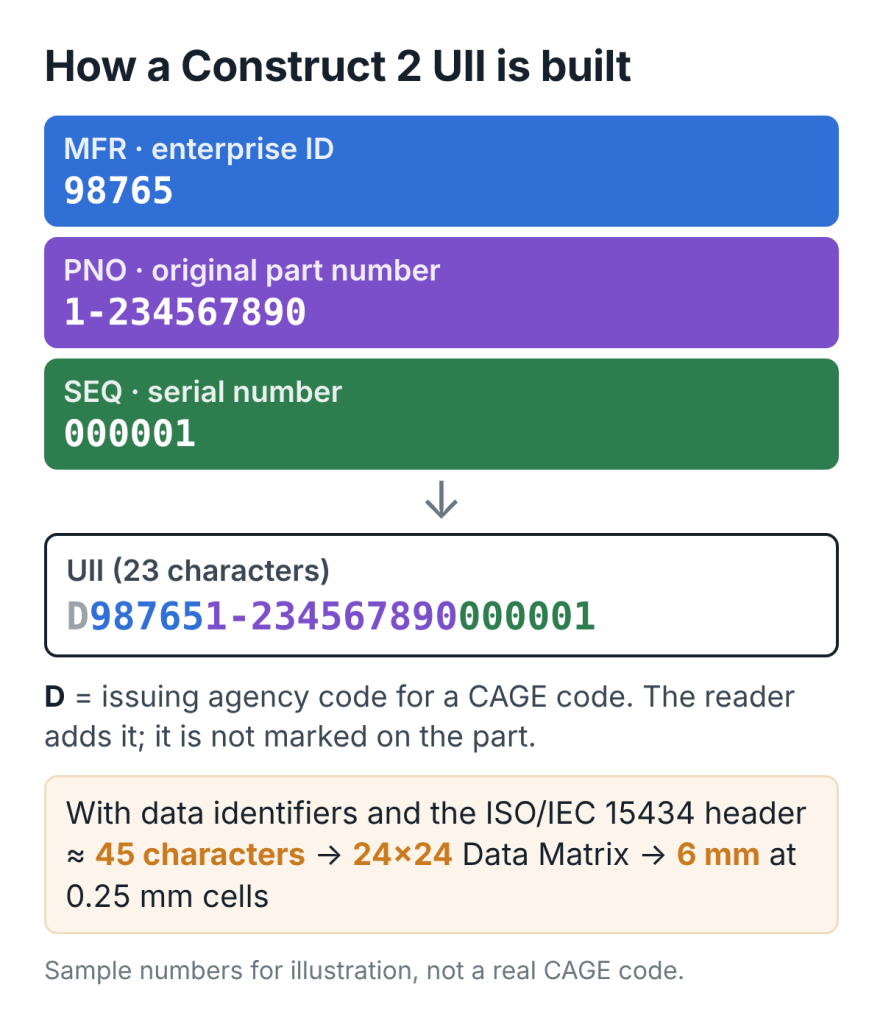
Joined with the agency code, this UII is 23 characters. The Data Matrix code carries more than the UII: data identifiers (short prefixes that tell the reader which field is which) and a header and trailer (the ISO/IEC 15434 format) add roughly 20 more. That is why this sample needs about 45 characters of space.
Capacities follow the ISO/IEC 16022 figures for alphanumeric data. Your marking software picks the exact size from the real string. Leave a blank border of at least one cell around the symbol so the reader can find it.
Pick the cell size from the surface. On machined stainless steel, 0.25 mm cells read well. On a rough casting, go to 0.4–0.5 mm. The symbol must still stay under 25.4 mm (1 in).
Not sure what cell size your part can take? Send us a photo of the marking area and the UII you need to fit.
Round parts need extra care. Section 5.2.7.2.3 limits the symbol to 16% of the diameter. On a 20 mm (0.79 in) shaft, that is 3.2 mm. Even at 0.19 mm cells, a 24×24 symbol is 4.6 mm. Mark a flat, a shoulder or a band instead.
Very small parts have two outs. Section 5.2 allows cells down to 0.025 mm (0.001 in) where space is limited, and section 5.1.2 lets the human-readable text move to the packaging. For more on the symbol itself, see our Data Matrix code guide.

How is a MIL-STD-130 mark verified and reported?
Section 5.2.7.2.1 lets the supplier pick one of three checks: ISO/IEC 15415 grade 3.0, ISO/IEC TR 29158 (AIM DPM) grade 2.0, or SAE AS9132. Read the Data Matrix code with equipment set up per Appendix A, then report the UII through WAWF.
A common belief says labels must use ISO/IEC 15415 and direct marks must use the DPM method. The standard does not say that. The choice is yours unless the contract or drawing names one.
ISO/IEC 15415
Minimum grade 3.0/05/650 (0.005 in aperture, 650 nm light).
Written for printed barcodes; suits labels and plates
ISO/IEC TR 29158 (AIM DPM)
Minimum grade DPM 2.0/7.5-25/650.
Written for direct part marks, with lighting angles for dot peen and laser marks
SAE AS9132
Pass the AS9132 checks and the part’s engineering spec.
Common in aerospace for dot peen, laser and electrochemical marks
On these scales, 3.0 is a B grade and 2.0 is a C grade. A phone app that scans a Data Matrix code is not a verifier (a calibrated camera that grades the mark).
When HeatSign marks a sample for a drawing, we grade it with the DPM method, so you see the same kind of number your customer will. For what the grades mean, see readable vs verifiable. For aerospace dot peen and laser rules, read our AS9132 compliance guide.
- 1
Mark a sample in the drawing location
Use the production machine, settings and cell size.
- 2
Run your real finish
Paint, blast, plate, heat-treat or clean it exactly as production will.
- 3
Grade it and keep the report
Grade before and after the finish, and file the report with the part record.

DFARS 252.211-7003 also asks you to read each mark with equipment set up per MIL-STD-130 Appendix A. That is the data-format check, separate from print quality. A Data Matrix code can scan fine and still fail if the data identifiers are wrong.
Want a sample graded? Send HeatSign the drawing and we will mark and grade a sample in the drawing location.
What else do DoD suppliers ask about MIL-STD-130?
Does MIL-STD-130 require direct part marking?
No. Section 4.1 allows a label, plate, band, tag or a mark on the part itself, and the design activity chooses on the drawing. Direct marking is the safer choice when the part will outlive a label or gets painted after marking.
What is the minimum Data Matrix cell size under MIL-STD-130?
The default range is 0.19–0.635 mm (0.0075–0.025 in), with the symbol no larger than 25.4 mm (1 in). Where space is limited, section 5.2 allows cells down to 0.025 mm (0.001 in), for example on electronic components.
Can a dot peen Data Matrix code meet MIL-STD-130?
Yes. Table II lists dot peen as suitable for 2D symbols, and you can verify it with the DPM method or SAE AS9132. HeatSign pneumatic and handheld dot peen markers mark Data Matrix codes on steel, castings and forgings.
Not sure whether your drawing calls for a label or a direct mark?
We see three mistakes again and again. An adhesive label goes on a part that is painted or blasted afterwards. A Data Matrix code is sized for a flat plate and then marked on a small round shaft. Someone stamps a 2D code with steel stamps, a method Table II does not suggest for 2D symbols.
Start from the drawing and the finish steps, not from the machine. If the drawing allows a direct mark, pick the method by material and test it through your real process before you commit. Send us the drawing, the material and the finish steps, and HeatSign will mark a sample in the drawing location and grade it.
Sources
- US DFARS 252.211-7003, Item Unique Identification and Valuation
- MIL-STD-130N with Change 1, Identification Marking of U.S. Military Property
- MIL-STD-130N Notice 1, validation notice
- MIL-STD-792F, Identification Marking Requirements for Special Purpose Components
- ISO/IEC 16022, ISO/IEC 15415, ISO/IEC 15434, ISO/IEC TR 29158 and SAE AS9132 (scope pages)
- Manufacturer datasheets for adhesive polyester UID labels and photo-anodized aluminum plates