


Start here: four machines that handle steel
Two of these four are fiber lasers. Two are dot peen machines that press the mark in with a hard pin. Pin machines come in two kinds, electric and pneumatic, and that choice decides how deep the mark goes.


Structural steel, pipe, valves, heavy equipment. Steel is the easiest metal to mark, and the hardest to keep marked. Beams go into molten zinc. Shafts go into a furnace. Castings go through a blast cabinet.
So the real question is not how to mark steel. It is what happens to the part next. HeatSign supplies fiber lasers for finished parts. For everything else, HeatSign supplies dot peen machines that press a mark deep enough to read through zinc, scale and paint.
Reply within one working day. Free marking test. No sample shipping needed. Working in stainless? See stainless steel marking.
Two of these four are fiber lasers. Two are dot peen machines that press the mark in with a hard pin. Pin machines come in two kinds, electric and pneumatic, and that choice decides how deep the mark goes.


A photo shows you what the mark looks like. A video shows you how long it takes, and how deep it goes. On the left, a HeatSign fiber laser marking steel in about two seconds. On the right, a dot peen machine pressing the same mark in.
Nothing touches the part. It marks a part in a few seconds, and the surface stays flat. This is the one to buy if your parts are finished and you mark them in batches.
A hard pin hammers the mark into the metal. Slower, and loud enough that you will hear it across the shop. But you can feel the dots with a fingernail, and that is what still reads after zinc, a furnace or a blast cabinet.
Send a photo and tell us what you need to mark. We mark the same material, film it, and send you the video. Nothing to pay, nothing to ship.
Find your part in the first column and read across. The second column decides the answer. If zinc, heat, grit or paint is still ahead, a surface mark will not be there at the end.
Send us a photo and tell us one thing: what happens to the part after marking. Zinc, heat, blasting, paint, or nothing at all. That one answer is enough for us to name the machine.
These are the failures HeatSign is asked about most. Each answer also names the case where our machine is the wrong buy.

Hot-dip galvanising drops the part into molten zinc at around 450 °C. The coat that comes out is 80 to 100 microns thick, sometimes more. A laser mark lives on the surface, so the zinc simply covers it.
Even a pressed mark can vanish if it is too shallow. That is why an electric unit at 0.3 mm is not enough here. Go to 0.5 mm or deeper with air, and the dots still read on the finished beam.

When steel is hardened in a furnace, a dark, flaky skin grows over the whole part. Workshops call it scale. A laser mark only changes the colour of the surface. The scale grows right over it, and the mark is gone.
There are two ways round this. Press the mark into the metal with a pin before the part goes into the furnace. Or wait until the part comes out, clean it, and then mark it with a laser. The one thing that does not work is laser marking first and heating after.

A pneumatic head is heavy. Ask an operator to hold one against a beam for eight hours. You get crooked marks, sore wrists, and a machine nobody wants to use.
A magnetic base solves it. Put the unit on the steel, flip the switch, and the magnet carries the weight. The marks come out straight because nothing is shaking.

Past about 62 HRC the steel is as hard as the pin. On a 60 HRC face a carbide tip leaves 0.01 to 0.05 mm. That is a scratch, not a readable mark. Pin wear climbs at the same time.
A laser does not care how hard the metal is. On parts that are already hardened, a laser is the answer and our dot peen range is the wrong buy.
Real HeatSign installations, with the numbers the customers measured. Names are withheld at their request.

Laser marks were fading under heat and mechanical stress. The plant moved to an electric dot peen station in pre-assembly. Depth is around 0.3 mm, a few seconds per part, three shifts a day.

Large castings could not be moved to a marking station, so the numbers were hammered in by hand. A handheld electric unit at 0.3 mm replaced that at final inspection, on rough cast iron and alloy steel parts.
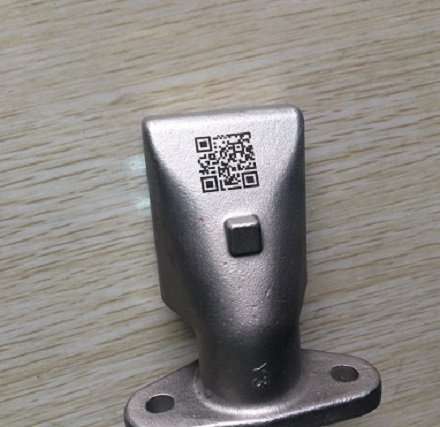
An etching process was slow and the marks faded. The plant wanted a permanent mark that never touches the metal, and that fits inside an automated line. They took an HS-FL30 fiber system.
Tell us what you mark today, how many parts a week, and what it costs you in rework. We will work out whether a change pays.
Most steel marking is done because a standard says so. Here is what four common ones ask for, in plain terms, and the HeatSign machine that meets each one.
Seventeen characters, no letters I, O or Q, plus a check digit in position nine. It has to be clear and impossible to remove quietly.
The pipe number, heat number, steel grade and test data go on the outside surface. Cold rolling or low stress dot marking is the named method.
CE marking needs an unbroken trail from mill to finished frame. The heat number is the physical link, and it has to reach site intact.
Machine readable identity means steel DPM engraving of a Data Matrix ECC 200 code. A graded read then proves it scans. Dot peen and laser are both named methods.
Need a machine that passes your audit? Tell us the standard and send a photo of the part. We will name the HeatSign machine that meets it, and mark a free test piece so you can check the result yourself.
Find the right machineSteel takes a laser mark more easily than almost any metal. That is why a cheap machine looks tempting here. Below is what it can do, and what it cannot.
A laser can make two kinds of mark on steel. At low power, moving slowly, it heats the surface until it turns dark grey or black. Nothing is cut away. At high power it burns a shallow groove into the steel, and the groove looks light and shiny.
Use the black mark for anything a scanner has to read, like data matrix codes and part numbers. Use the shiny mark for words people read from a distance. Both are permanent laser marking on steel. The mark is part of the metal itself, so it cannot peel or rub off like paint or a label.
One limit. Neither mark survives galvanising, shot blasting or a furnace. Only choose between black and shiny if the part is already finished. For the deepest marks, see deep dot peen marking.


A small hobby laser can mark steel. The steel is not the problem. The machine is. A hobby laser is made to run a few hours at a time. A factory needs one that runs all day, every day, for years.
Depth is the second problem. For a mark you can feel with your finger, a laser has to pass over the same spot many times. A dot peen pin does it in one go.
Every HeatSign machine on this page is built to run all day in a factory. A cheap machine that breaks down, or wears out in a year, ends up costing more for every part you mark.
Get in touch with us
Reply within one working day
Seven answers you will not find above. All of them come up in real HeatSign quotations.
It depends on the machine.
A dot peen machine does not need clean steel. The pin pushes through rust, oil, old paint, and the dark skin that steel has when it leaves the mill. You can mark parts straight from the saw or the casting line.
A laser needs a cleaner surface. Oil burns and gives off smoke, and a dirty surface gives a different result on every part. Wipe the part with a cleaning solvent first. If the steel has a thick, flaky layer on it, remove that before marking.
No. Most jobs need no holding at all.
With a bench machine, the part goes to the machine. Nobody holds anything.
The handheld laser head weighs under 1.5 kg. That is light enough to hold for short jobs. For long runs, ask us about a stand so it does not have to be held.
The handheld dot peen machine is heavier, about 5 kg. On steel, a magnetic base holds it in place for you. Put it on the part, turn the switch, and let go. The magnet carries the weight, so every mark comes out straight.
On round or uneven parts, where a magnet cannot sit flat, a clamp does the same job. Tell us the shape of the part and we will suggest one.
Very little, if you put it in the right place. A dot peen pin makes many light taps. A hand stamp makes one hard blow. Light taps put far less stress into the metal.
Mark a flat area, away from corners, grooves and any part that bends in use. If the drawing does not allow pressed marks, use a laser instead.
About 62 HRC is where a pin stops working. Up to 55 HRC a carbide tip marks normally. Between 55 and 62 it still marks, but the dots get shallow and the pin wears out far faster.
Past 62 the tip is no harder than the part. On a 60 HRC face you get 0.01 to 0.05 mm, which reads as a scratch. Mark those parts with a laser, or press the mark in with a pin before they are hardened.
Set the first serial number, for example 1001. The machine adds one for each new part: 1001, 1002, 1003, and so on. It can also add today’s date or the shift number to every mark on its own.
Already have a list of numbers? Load it from an Excel file, or scan the barcode on your work order. The machine marks them in order, one per part. No typing means no typing mistakes.
Very little. Here is the full list.
Fiber laser: it uses no ink, no labels and no other supplies. If you mark oily or coated steel, add a fume extractor to clear the smoke.
Electric dot peen: only the pin wears down. A new pin is cheap and takes a few minutes to fit.
Pneumatic dot peen: pins, plus compressed air. If your shop has no air line, you will also need a compressor.
The marking software comes with every machine. There is no licence to pay for each year.
It can, on plain steel with nothing on it. A laser mark leaves the surface a little rough, so water stays there longer than on the smooth metal around it. If parts are stored somewhere damp, the mark may show rust first.
Usually this does not matter, because the part gets painted, oiled or coated later. If it stays bare and sits outdoors, choose a dot peen mark. A pressed dent stays readable even when the surface rusts.
Just an email or a message with these three answers.