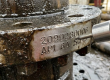
Is laser marking readable after painting or galvanizing? Often it is not. A steel shop marks a part number on every plate. The plates go out to be galvanized. They come back, and half the numbers are gone. Now the site crew has to match parts to drawings by hand.
A mark that looks sharp on the bench can disappear under paint, zinc or blasting. The fix is simple: the mark must be deeper than what the finish adds or removes.
For hot-dip galvanizing, the American Galvanizers Association (AGA) asks for marks at least 0.8 mm deep and 13 mm tall. This guide shows the depth you need for each finish, which machine can do it, and when it is easier to mark after coating.

The short version
- Galvanizing: mark at least 0.8 mm deep and 13 mm tall, or hang a steel tag on the part.
- A fast laser mark is usually not readable after painting or galvanizing. It is only a thin dark layer. Paint covers it, and the acid bath removes it.
- Easy rule: make the mark about 10 times deeper than the zinc layer.
- Scannable codes fail before text. A Data Matrix code (a small square barcode) needs bigger dots, or should be marked after coating.
- Always test a few marked parts on your real finishing line first.
Words used in this guide
- Hot-dip galvanizing
- Dipping steel in melted zinc so it does not rust.
- Dot peen marking
- A hard pin hits the metal many times and presses dots into it. The dots form letters, numbers or codes.
- Laser marking
- A laser beam darkens the metal surface. It is fast, but it goes in very little depth.
- Laser engraving
- A laser that burns away metal to make a groove. Deeper, but slower.
- Powder coat / e-coat
- Two common paint finishes. Powder coat is thicker. E-coat is a thin paint layer.
- Data Matrix code
- A small square barcode, like a QR code, marked on the part. A scanner reads it to get the serial number or part data.
- Pass
- One run of the laser over the mark. More passes make a deeper mark, but take longer.
- µm (micron)
- One thousandth of a millimeter. A human hair is about 70 µm thick.
Why Do Part Marks Disappear After Galvanizing, Blasting or Painting?
A finish can hide a mark in three ways. A coating fills it in: hot-dip zinc adds about 45–85 µm. Blasting grinds off the top layer. Acid and heat wipe out light laser marks. So the mark must be deeper than the finish.
Think of it like snow on a road sign. A thin layer is fine. A thick layer covers the letters. Some finishes add a layer on top of your mark. Some remove the surface the mark sits in. Some attack the mark with acid or heat.
What the finish does | Examples | What happens to the mark |
|---|---|---|
Adds a layer | Zinc, powder coat, e-coat, paint | Fills the dents or covers the dark mark |
Removes a layer | Shot blasting, sand blasting | Grinds away light and shallow marks |
Attacks the mark | Acid cleaning, heat treatment | Wipes out light laser marks |

Hot-dip galvanizing does all three. First the steel is cleaned in acid. Then it goes into melted zinc at about 450 °C (840 °F). So ask one question: is my mark deeper than what this process adds and takes away?
How Deep Does a Mark Need to Be for Each Finish?
For hot-dip galvanizing, mark at least 0.8 mm (1/32 in) deep and 13 mm (1/2 in) tall, as the American Galvanizers Association advises. Thin e-coat paint is easy. Blasting, powder coat and thick paint are in between.
Find your finish in the table. It tells you how deep to mark and which tool works.
Finish | What it does to your mark | How deep to mark | Tool that works |
|---|---|---|---|
Hot-dip galvanizing | Acid bath, then 45–100 µm of zinc (ISO 1461, ASTM A123) | 0.8 mm or more, 13 mm tall (AGA) | Deep pneumatic dot peen, stamping, or a steel tag |
Shot or sand blasting | Grinds the surface; leaves a rough layer about 75–127 µm deep | Deeper than the rough layer, with room to spare | Pneumatic dot peen, or laser engraving with many passes |
Powder coating | Adds 60–80 µm of paint and bakes at 120–200 °C | Several times the paint thickness | Pneumatic dot peen, or laser engraving |
E-coat | Adds a thin paint layer, about 18–28 µm | Shallow marks are fine; for Data Matrix codes, make each square 1.25 mm or larger | Fiber laser or dot peen |
Thick protective paint (outdoor steel) | Several coats, often 320–500 µm in total | Text: deep dot peen. Data Matrix codes: mark after painting | Mark after painting, or use a steel tag |
Heat treatment | Heats the part; light laser marks fade above about 200 °C | Any real dent or groove | Dot peen or laser engraving |

How thick is the coating? How deep is the mark?
Same scale. 1 mm = 1,000 µm. A human hair is about 70 µm.
CoatingMark depth
An Easy Rule for Galvanized Parts: About 10 Times the Zinc
The AGA asks for 0.8 mm. On steel thicker than 6 mm, the zinc layer is usually at least 85 µm (ISO 1461). 0.8 mm is about 10 times that.
Rule of thumb: make the mark about 10 times deeper than the zinc.
This is our own math, not an AGA rule. It helps when your galvanizer says the zinc will be thicker than usual.
Does the Steel Thickness Change the Depth?
Yes. Thick steel picks up more zinc than thin steel. Heavy beams and castings need the full 0.8 mm. Thin brackets (under 1.5 mm) get about 45 µm of zinc, so about 0.5 mm is a safe start. Still test it.
Not sure which row fits your part?
Tell us the material, the finish and how many parts you mark a day. An engineer will reply with the depth and the machine we would use.
Is Laser Marking Readable After Painting or Galvanizing?
Usually not. A fast laser mark is only a thin dark layer on the surface. Colored paint covers it, and the galvanizer’s acid bath removes it. A deep laser engraving can survive, but reaching 0.8 mm takes dozens of passes on every part.
When a fiber laser marks steel quickly, it only darkens the surface. There is almost no depth. Under primer or colored paint, that dark layer is simply hidden. Before galvanizing, the steel is cleaned in acid to remove rust and dark layers, so the laser mark goes with them.

A dent is different. Thin paint can cover the color, but it does not fill a deep dent. You can still see the letters by their shadow.

A laser can also engrave, which means it burns away metal. But one pass (one run of the laser) removes only about 0.01–0.02 mm in our experience. To reach 0.8 mm, you would need dozens of passes. That is too slow for most production.
So is laser marking readable after painting? Only when the mark is a deep engraving. If parts are painted or galvanized after marking, a fast laser mark is the wrong tool. A laser is a good choice after the finish. It marks the finished zinc or paint cleanly and fast.

Dot Peen or Laser: Which One Holds Up Better?
Dot peen is the safer choice before galvanizing and thick paint, because it presses deeper. A laser is better for thin e-coat, small Data Matrix codes and fine logos. Both can survive blasting, but a laser needs about 12 passes for each Data Matrix code.
Here is how the two compare for each finish.
Before this finish | Pneumatic dot peen | Laser engraving (deep) | Laser marking (fast, light) |
|---|---|---|---|
Hot-dip galvanizing | ✅ Yes, about 1 mm deep | ⚠️ Possible, but very slow | ❌ No |
Shot blasting | ✅ Yes | ✅ Yes, about 12 passes | ❌ No |
Powder coating | ✅ Yes | ✅ Yes | ⚠️ Risky |
E-coat | ✅ Yes | ✅ Yes | ⚠️ Risky |
Heat treatment | ✅ Yes | ✅ Yes | ❌ No |
Small Data Matrix codes and logos | ⚠️ Limited | ✅ Yes | ✅ Yes |
Time per part | A few seconds to 15 s | Up to ~37 s for a Data Matrix code that survives blasting | Fastest |
The laser numbers come from one laser supplier’s published tests on die-cast parts. Our standard pneumatic dot peen machines reach about 1 mm deep. Custom builds can reach about 2 mm in softer metals. A small electric dot peen marker (about 0.05–0.3 mm per pass) is not deep enough for galvanizing.

Which Machine Should You Look At?
Pick by the size of your parts and what happens to them next.
 Handheld Pneumatic Dot Peen MarkerA strong handheld pneumatic marker for beams, frames and thick steel. It punches deeper than a standard dot peen, so numbers last through zinc, blasting and paint.View machine →
 Desktop Pneumatic Dot PeenFor small and medium parts on a bench or a line. About 1 mm deep. Good before blasting, powder coat or zinc.View machine →
 Desktop Fiber LaserFor marking after coating, e-coated parts, small Data Matrix codes and logos. Fast and clean.View machine →
Should You Mark Before or After Painting or Galvanizing?
Mark after coating when you can, because then nothing can cover the mark. Mark before coating only when you must track each part through the finishing line. Then mark at least 0.8 mm deep, or hang a steel tag on it.
Do you need to track each part through the finishing line?
Yes → mark before coating
Look at the toughest step the part goes through:
- Galvanizing: dot peen 0.8 mm or deeper and 13 mm tall, or a steel tag
- Blasting or powder coat: pneumatic dot peen, or deep laser engraving (make Data Matrix codes large)
- E-coat or thin paint: fiber laser or dot peen
- Thick outdoor paint: mark Data Matrix codes after painting
No → mark after coating
Use dot peen or a laser on the finished surface. On outdoor steel, touch up the paint around the mark.
Your situation | What to do |
|---|---|
Each part must be tracked through the galvanizer or paint line | Mark before: deep dot peen 0.8 mm or more, or a steel tag tied on with wire (AGA) |
You only need the number when you ship or install | Mark after: dot peen or laser on the finished surface |
The part will be outdoors or near chemicals | If you mark after coating, touch up the paint around the mark |
The part is bent or machined after marking | Keep Data Matrix codes at least 15 mm from bends and cut edges |
Safety-critical structural parts | Do not stamp them (AGA). Use a tag, or ask the designer |

Three mistakes come up again and again:

Writing numbers in paint
Oil paint and crayon do not wash off in the acid bath. The zinc will not stick there, and the galvanizer may charge you to fix it. Use a water-based marker for temporary numbers.

Marking too close to a bend
A Data Matrix code 5 mm from a bend can stretch so much that it no longer scans. Keep it at least 15 mm away.

Forgetting the paint after marking
Marking a painted part can crack the paint around the mark. On outdoor steel, plan a quick touch-up.
How Do You Keep a Data Matrix Code Readable Under a Coating?
Make the code squares bigger and test a coated sample. Published tests used 0.6 mm squares to survive shot blasting and 1.25 mm squares under e-coat. Under thick paint (320 µm or more), mark the code after painting.
A Data Matrix code is a small square barcode, a bit like a QR code. Factories mark it on parts so a scanner can read the serial number.

A person can still read letters under paint from their shadow. A scanner cannot do that. It needs clear contrast between the tiny squares. Paint fills the squares first, so codes fail before text does.

Finish | Code square size that worked | Tip |
|---|---|---|
Shot blasting | 0.6 mm | Coarser blasting grit needs bigger squares |
E-coat | 1.25 mm | Squares of 0.75 mm or smaller did poorly (e-coat film thickness) |
Thick paint (320–500 µm) | — | Mark the code after painting, or use a tag |
Rough castings | 0.4 mm or more (our experience) | A rough surface breaks up small squares |
If a customer audits your Data Matrix codes, “it scans in the shop” is not enough. Check the code after the finish, and grade it with the standard made for marks on metal: ISO/IEC 29158.
How Should You Test a Mark Before Production?
Mark five to ten real parts. Send them through your real galvanizer or paint line. Then read the text, scan the Data Matrix codes and check their grade (a quality score from a code checker). A test batch costs a few days. A failed production run costs far more.
Step | What to do | What to write down |
|---|---|---|
1 | Mark real parts at 2–3 different depths | Machine, settings, measured depth |
2 | Send them through the real finishing line | Finish type, coating thickness |
3 | Read the text; scan and grade the Data Matrix codes | Which depth passed, which failed |
4 | Pick the shallowest depth that passed | Final settings, time per part |
Choose the shallowest depth that passes, not the deepest. Deeper marks take longer and wear the pin faster.


Planning a test or choosing a machine?
Send us your part photos, material and finishing steps. Our engineers will suggest the machine, the depth and the settings to start with.
Frequently Asked Questions
Is laser marking readable after painting?
A fast, light laser mark usually is not. Paint covers the thin dark layer. A deep laser engraving or a deep dot peen mark stays readable under thin paint. Under thick paint, mark after painting.
Can you laser mark steel that is already galvanized?
Yes. That is a different job from marking before galvanizing. A fiber laser marks the finished zinc cleanly and fast. See our guide to laser engraving galvanized steel.
Does a dot peen mark survive powder coating?
Yes, if it is several times deeper than the paint. Most powder coats are 60–80 µm thick. Start with a mark about 0.3 mm deep, then test a coated part. Small Data Matrix codes need bigger dots, or mark them after coating.
Will a laser mark survive heat treatment?
A fast, light laser mark fades above about 200 °C. A deep laser engraving survives: one published test could still read it after 520 °C for 4 hours. Dot peen marks are not affected by heat.
Can I write part numbers in paint before galvanizing?
No. The AGA warns that oil paint and crayon do not come off in the acid bath. The zinc will not stick there. Use a water-based marker, a steel tag, or a deep stamped or dot peen mark.
What is the difference between dot peen and laser marking?
Dot peen uses a hard pin to press dots into the metal, so the mark has real depth. Laser marking uses light to darken the surface, which is faster and finer but shallow. For parts that get coated later, depth matters most.
What Should You Decide First?
The most common mistake is choosing the machine first and the finishing process second. People buy a laser because the marks look great at a trade show, then send the parts to a galvanizer. Or they buy a small electric marker for a shop that blasts every part.
Do it the other way around. Asking “is laser marking readable after painting?” is a good start, but the answer depends on the paint and the depth. List every step the part goes through after marking. Take the toughest step and find it in the depth table. That row tells you how deep to mark, which tool works, and whether to mark before or after.
Want a second opinion? Tell us about your parts and your finishing line. We will tell you honestly which machine fits, even if it is not the most expensive one.
Sources
- American Galvanizers Association, Marking Parts
- American Galvanizers Association, ASTM A123 overview
- Galvanizers Association (UK), EN ISO 1461 coating thickness
- Galvanizers Association of Australia, Identification and Marking
- ISO 8503-1; SSPC surface preparation guides (blast profile)
- Institute of Corrosion, ISO 12944-5 protective paint systems
- Products Finishing, E-Coat Film Thickness Capabilities
- ISO/IEC 29158, direct part mark quality guideline
- Published post-treatment marking tests by a North American laser supplier