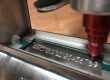
Yes, a laser wood stripper works, if it is a pulsed laser (one that fires in very short bursts). It strips most oil-based paint, varnish, shellac and old dirt from solid wood without sandpaper or chemicals. It struggles with water-based finishes, stains that soaked deep, and very thick coatings. A 200–500 W machine costs about $6,500–13,000.
At HeatSign, this page brings us more machine questions than any other article on our site. Most come down to three things: will it work on my piece, will it burn the wood, and what does it cost. Here are the answers, including when a laser is the wrong tool.
Strips clean
- Oil-based paint and primer
- Oil-based varnish
- Shellac
- Old dirt and grey weathering
Test first
- Water-based or latex paint
- Gel stain that soaked into the grain
- Car clear coat
- Carvings and deep grooves
Avoid
- Coatings a few millimetres thick
- Thin veneer and MDF you want to keep
- Painted antiques with historic value
- Stripping with a continuous-wave (CW) cleaner
Quick verdict, based on public test videos and lab work. Details and sources below.
Can a laser really strip paint and varnish off wood?
Yes, if it is a pulsed laser. Very short pulses (a few billionths of a second each) turn the coating into vapor before heat soaks into the wood. A continuous-wave (CW) laser heats the same spot non-stop and scorches it. A “laser sander” strips coatings; it does not smooth wood.
This is called laser ablation. Each pulse hits the coating, and the top layer flashes off as fine smoke and dust. Paint and varnish take in the beam better than bare wood, so they go first.

Pulsed laser: the wood stays safe
- In a lab test, shellac came off oak and pine at lower energy than the wood could take. That gap is your safety margin.
- The wood did not change color.
- In a video test, a 200 W pulsed cleaner left old oak “barely warm to the touch.”
Continuous-wave (CW) laser: the wood burns
- A 2,000 W CW cleaner was “toasting the surface of the wood” in the same test.
- White paint caught fire and left low spots.
- Cheap 1,000–2,000 W “laser cleaners” are often CW. Check before you buy.
Sources: Aligizaki et al., e-Preservation Science (1064 nm laser, the same wavelength HeatSign’s pulsed fiber cleaners use), 6th Gear Garage test video. To check a spec sheet, see pulsed vs continuous-wave laser cleaners.
What “laser sander” really means. The name went viral on short videos, but the machine does not grind. It will not flatten a bent board, remove dents or level rough grain. It only removes what sits on top of the wood. As woodworkers on Reddit put it: it replaces sandblasting and chemical stripper, not sanding.
Which wood finishes strip clean, and which fight back?
Oil-based paint, varnish, shellac, primer and old dirt usually strip clean. Water-based finishes, gel stains that soaked into the grain, car clear coats and very thick coatings (a few millimetres) are slow, leave a tint, or burn. Test before you quote the job.
This table pulls together two public test videos and lab work. Use it as a starting point, not a promise.
Finish on the wood | What usually happens | What to plan for |
|---|---|---|
Oil-based paint, primer | Strips clean Comes off clean, often in one or two passes | Normal job |
Oil-based varnish, shellac | Strips clean Strips well; the wood grain shows clearly | Normal job |
Old dirt, grey weathering | Strips clean Lifts easily, even on 150-year-old oak floors | Normal job |
Water-based finish or stain | Test first Little or no effect at the same settings | Test first; quote more time |
Latex paint (white is slowest) | Test first Comes off, but white takes 2–4× longer than dark colors | Quote more time |
Gel stain soaked into the grain | Test first Surface stain goes; a light tint stays | Plan a light sanding |
Car clear coat | Test first Hard to remove | Test first or use another method |
Coatings 2–3 mm (0.08–0.12 in) thick | Avoid The thick spots burn, and the burn spreads | Scrape most of it off first |
Veneer or laminate over MDF (pressed wood-fiber board) | Avoid Can turn orange; a second pass makes it lighter | Test on a hidden spot |
Sources: Laser Engraving 911 test video, 6th Gear Garage test video, Aligizaki et al.
Finish not on this list? Email us a photo of it and we will tell you what to expect.

Why oil-based and water-based act so differently: water-based finishes sink deeper into the wood. Less of the finish sits on top for the laser to remove. In one test, the same 500 W machine and settings stripped an oil-varnished chair “with ease” but had “almost none to little effect” on a water-based stained frame.
How do you tell oil-based from water-based in 10 seconds?

The alcohol test
Rub a small hidden spot with 90% isopropyl alcohol (rubbing alcohol) on a cloth.
One restorer calls the gummy feel “a dead giveaway.” He does the test before he takes a job, “so you don’t disappoint the customer.” It takes less time than writing the quote.
Which woods and shapes are more likely to burn?
Softwoods like pine take damage at lower energy than dense hardwoods like oak. Carvings and grooves hold more coating, so you tend to keep the beam on one spot. Veneer and MDF can change color. Use a lower setting and more passes on these pieces.


In a demo on historic trim, the deep grooves showed slight burn marks. The person doing the demo said they could be sanded out. On pine, another tester saw small black spots in a gloss clear coat; most of them wiped off.
If you read older guides, including an earlier version of this page: softwood is not “easier” to strip. The coating may come off fast, but the wood also marks sooner. Go gentle on pine.
How do you strip wood with a laser without burning it?
Start low and fast. Use a lower pulse energy, keep the beam moving, make several light passes instead of one heavy pass, and stop as soon as bare wood shows. Once wood starts to burn, it keeps burning, so always test on a hidden spot first.
Burning is mostly about how you use the machine. A bigger machine does not fix it. Follow these five steps on every new piece.

- Check the finish Do the alcohol test above. Note the wood type and any carvings.
- Pick a hidden test spot The underside of a tabletop, the back of a door or the inside of a leg.
- Start low and fast Begin with lower power and a fast scan. One tester ran 100% power to save time and said lower power is “more forgiving” on wood.
- Make light passes and stop at bare wood Two or three light passes beat one slow, heavy pass. Do not keep going over clean wood “to make sure.”
- Write down what worked Note the setting for that wood and that finish. Your next quote gets faster and more accurate.
Two settings matter most:
Ask about pulse energy before you buy. The same 300 W laser source is sold in 2, 5 and 15 mJ versions. Two machines can both say “300 W” and act very differently on wood. For furniture and trim, the strongest version is not always the right one. HeatSign’s standard 300 W cleaner uses the 5 mJ version.
Not sure which version fits your work? Send us a photo of the piece and the finish. We will tell you which one we would use.
Do you still need to sand after laser stripping?
Usually, yes, a light pass. The laser removes the coating, but it can raise the grain, leave a faint tint where stain soaked in, or darken edges. A light sanding with fine sandpaper evens the surface before the new finish. It will not fix dents or deep scratches.
The laser replaces the hard part of the job: the chemical stripper, the scraping and the rough sanding. You keep the last, light sanding that every good finish needs.

Plan a light sanding when:
- A stain had soaked in and left a tint
- You see small dark marks in grooves or on soft grain
- The new finish is a clear coat, which shows every flaw
- The wood had dents, scratches or rough grain before you started
Is it safe to laser-strip old paint that might contain lead?
Treat it as lead work. In the US, paid work that disturbs paint in homes, schools or daycares built before 1978 falls under the EPA’s RRP rule. A laser turns paint into fumes, so plan for fume extraction with HEPA filters, a respirator, plastic sheeting and a certified renovator.
Old house? Check for lead before you quote
The RRP rule is the EPA’s Renovation, Repair and Painting program (40 CFR Part 745, Subpart E). Three numbers matter:
Sources: EPA contractor guide, 40 CFR 745.85.

The rule does not name lasers. But a laser does disturb paint and turns it into fine dust in the air. The safe choice is to treat it as covered work. That means a certified renovator (a worker with EPA lead training), plastic sheeting around the area, HEPA fume extraction at the gun, and a proper cleanup.
This is not legal advice. Check with your state or local lead program before you take paid jobs on old houses.
Two more safety points apply to every wood job, lead or not:
- The laser itself. Pulsed cleaners are Class 4 lasers, the highest class: the direct or reflected beam can hurt eyes and skin. Everyone nearby needs OD4+ safety glasses made for 1064 nm. HeatSign’s pulsed cleaners are reported to the FDA’s CDRH, the US office that oversees laser product safety. See our guide to Class 4 laser safety.
- The smoke. Old varnish and paint burn off as fine particles. Use a fume extractor near the gun, even outdoors.

Which laser power do you need for wood restoration work?
For furniture, doors and trim, a 200–300 W pulsed cleaner is enough. Choose by pulse energy and cleaning width, not watts alone: the same 300 W source comes in 2, 5 and 15 mJ versions. Save 500 W for big beams, floors, log walls and thick paint.
 200 W pulsed cleaner · about $6,500Small furniture, frames, spot repairs. Draws under 600 W from the wall.See the 200 W machine →
 300 W pulsed cleaner · about $7,500The usual shop choice for furniture, doors, cabinets and trim. 140 × 80 mm (5.5 × 3.1 in) cleaning area. Max 1,500 W, built for 110 V or 220 V: a standard wall outlet works.See the 300 W machine → 500 W500 W pulsed cleaner · about $13,000Beams, floors, log walls and thick paint. 220 × 80 mm (8.7 × 3.1 in) cleaning area. More power to control on soft wood.Get a 500 W quote →

Details that matter more than watts:
- Gun weight: the HeatSign 300 W gun weighs 1 kg (2.2 lb). That counts on a full day of trim work above your head.
- Cooling: the 200 W and 300 W units are air-cooled. No water tank to fill or freeze.
- Cable length: the 5 m (16 ft) fiber cable lets the machine stay on the floor while you reach a door or a row of cabinets.
- Power: the 300 W unit draws about 10 A on a 120 V outlet. Do not share that circuit with a dust collector or a table saw.
How much does a laser wood stripper cost, and should you rent first?
HeatSign’s pulsed machines cost about $6,500 (200 W), $7,500 (300 W) and $13,000 (500 W). Retail listings often show $10,000–19,000. A US rental yard lists a 500 W pulsed unit at about $650. If you only strip a few pieces a year, rent or hire a laser restoration service first.
Option | Typical cost | Makes sense when |
|---|---|---|
200 W pulsed, buy | About $6,500 | Small pieces and spot work |
300 W pulsed, buy | About $7,500 | Steady furniture, door and cabinet work |
500 W pulsed, buy | About $13,000 | Large surfaces every week |
Rent a 500 W unit | About $650 per rental, plus a $30 safety course | You want to try the method on real jobs first |
The rental price is from a US equipment rental listing, which also asks for a $30 Class 4 safety course. To compare renting, hiring a service and buying by days of use, see laser cleaning machine rental vs buying.
Why do prices for “the same 300 W” vary so much? Pulse energy, the laser source brand, the cleaning width and what comes in the box all change the price. Our guide on what changes the price of a laser cleaner explains each part.
We do not promise a payback time. It depends on how many pieces you strip, which finishes they have, and what you charge. Work it out with your own job list, not a video’s promise.
Before you buy, have these ready
- The finishes you see most (do the alcohol test)
- The woods you work on
- Your largest piece
- Your power supply (110 V or 220 V)
With that list, we can tell you which power and pulse energy fit.
FAQ
Does laser sanding actually work on wood?
It works for stripping, not for sanding. A pulsed laser removes paint, varnish and dirt from the surface. It does not flatten wood, remove dents or smooth rough grain. Most jobs still end with a light sanding before the new coat.
Can a laser remove stain from wood, not just paint?
Partly. Oil-based stain on the surface strips well. Stain that soaked deep into the grain, like many gel or water-based stains, often leaves a light tint. A second light pass or a light sanding usually evens it out.
Can I use a diode laser engraver to strip paint from wood?
No. Diode engravers in the 10–20 W range are made to mark and engrave. They do not give the short, strong pulses that strip a coating. Wood stripping needs a pulsed laser cleaner, usually 200 W or more.
Is laser stripping faster than chemical stripper?
On oil-based finishes it often is, because there is no waiting and no scraping. On water-based finishes it can be slower than chemicals. The finish decides the speed more than the machine does, so test on the finishes you see most.
Can you test my piece before I buy?
Yes, you can send HeatSign a sample piece to test. Most buyers start with clear photos of the piece and the finish instead. That is quicker, and it often tells us enough to suggest a machine.
The last check before you buy
The most common mistake is buying on watts and a viral video. Before you spend $6,500 or more, do the alcohol test on the pieces you see most often. If most of them have water-based finishes, a laser will not be your main stripping tool, whatever its power.
If most have oil-based paint, varnish or shellac, a 300 W pulsed cleaner with the right pulse energy will change how your shop works. Send HeatSign your list of finishes, woods and largest pieces. We will suggest a machine and a starting setting.
Sources
- Aligizaki E.M., Melessanaki K., Pournou A., “The use of lasers for the removal of shellac from wood,” e-Preservation Science
- US EPA, Renovation, Repair and Painting Program: Contractors
- 40 CFR 745.85, Work practice standards
- Laser Engraving 911, Restoring Furniture With Lasers – Is it Magic? Or Madness?!
- 6th Gear Garage, Removing Stain & Paint with Laser Cleaning Machine