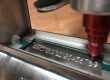
A perfume counter that engraves a name on each bottle and a brewery that prints a lot code on 20,000 bottles an hour both search for a glass bottle engraving machine. They need two very different machines.
A glass bottle engraving machine is one of two things. For names, logos and small batches, use a desktop UV laser marker with a rotary axis. For date and lot codes on a filling line, use a flying CO2 or UV laser synced to the conveyor. Volume decides which.
At HeatSign, we build both kinds. This guide shows how to pick one by bottles per hour, bottle shape and where the mark goes. You will also see what each bottle costs to mark and what to send a supplier before you buy.

Personalization station
Desktop UV laser marker + rotary axis
- For: perfume and gift counters, distillery shops, events, small brand runs
- Marks: a different name, date or logo on each bottle
- Speed: about 40–48 bottles an hour (see below)
- Price: HeatSign desktop UV machines cost $3,000–5,900
Line coder
Flying CO2 or UV laser on the conveyor
- For: wineries, breweries, distilleries, cosmetics and pharma filling lines
- Marks: the same date code, lot code or QR code on every bottle
- Speed: set by your line; the bottle never stops
- Price: flying laser markers from $3,800–9,000
4 words to know first
A note on bias: I work for HeatSign. We build desktop and flying UV, CO2 and fiber laser marking machines. Speed figures from other makers come from their public pages, listed at the end.
Which glass bottle engraving machine do you need: personalization or line coding?
Count bottles per hour and ask where the mark goes. Up to a few hundred bottles a day, each with different text, use a desktop UV laser marker with a rotary axis. Thousands an hour with the same mark on every bottle need a flying laser on the line.
The laser type comes second. Most buyers start with “UV or CO2?” and skip the bigger question: does the bottle stop, or does it move? Use this table to find your side first.
Your situation | Personalization station | Line coder |
|---|---|---|
Bottles per day | Tens to a few hundred | Thousands to hundreds of thousands |
What changes per bottle | The name, date or design | Usually nothing, or a serial number |
Is the bottle moving? | No. Someone loads it by hand | Yes. It passes on the conveyor |
Typical mark | Name, logo, message, limited-edition number | Date code, lot code, QR code, brand mark |
Typical buyer | Perfume counter, distillery shop, gift business, small brand | Winery, brewery, bottling plant, cosmetics or pharma filler |
HeatSign machine and price | Desktop UV + rotary axis, $3,000–5,900 | Flying CO2 (HS-CLY40 / 60) or flying UV (HS-UV10), $3,800–9,000 |
Some buyers need both. A craft distillery may print a lot code on every bottle on the line and also engrave gift bottles in the shop. That is two machines, not one machine doing two jobs.
 Desktop UV laser markerFor names and logos on perfume and spirit bottles. 5 W or 10 W, with a rotary axis.$3,000–5,900See the UV laser marking machine →
 Flying CO2 laser coderFor date and lot codes on thick glass bottles at line speed. 40 W or 60 W RF tube.From $3,800See the flying CO2 laser coder →
 Flying UV laser coderFor scannable QR and Data Matrix codes and thin cosmetic glass on the line.$6,000–9,000See the 10 W UV laser coder →
Not sure which side you are on? Send us a photo of your bottle and your daily volume.
Lasers are not the only way to personalize glass. Some shops use mechanical diamond-tip engravers, which carve a white groove that can be filled with gold or silver wax. A laser gives a frosted, sandblasted look and needs no tool changes.
How many bottles per hour can each setup mark?
A 5 W UV laser marker with a rotary axis marks a 40 × 15 mm (1.6 × 0.6 in) name on a 75 mm (3 in) bottle in about one minute. With loading, that is roughly 40–48 bottles an hour. On a line, conveyor speed sets the output.
Desktop: the laser time is fixed, the loading time is not
We timed this job in the HeatSign sample room. The setup: a 5 W UV laser marker, a 75 mm (3 in) wine bottle, and a name or logo about 40 × 15 mm (1.6 × 0.6 in). The laser needs about one minute. Loading the bottle, centring it and taking it off depends on the operator.
Step | Time per bottle | What changes it |
|---|---|---|
Load and centre the bottle in the rotary axis | About 15–30 s (our assumption) | Operator skill, a jig for your bottle |
Laser marks the name or logo | About 60 s (HeatSign test) | Mark size, fill density, laser power |
Take the bottle off | Included above | — |
Total | 75–90 s → 40–48 bottles an hour | About 320–380 bottles in an 8-hour shift |
A smaller mark or an outline logo instead of a filled one cuts the laser time. A trained operator with a fixed jig cuts the loading time. A patent on laser-coding bottles makes the same point: moving each bottle into position can take longer than the marking itself.
Line coder: the bottle never stops
On a line, a photo sensor sees each bottle and an encoder reads the belt speed. The laser marks the bottle as it passes. The output is your line speed, as long as the mark fits in the time the bottle spends under the lens.

Large makers of beverage coders publish high figures. Linx rates its 60 W CO2 coder at up to about 70,000 bottles an hour. Domino rates a 100 W model at up to about 90,000. Macsa quotes up to 200,000 for its top model. These are maker ratings for short date codes, not for logos.
HeatSign’s flying CO2 markers use an RF metal tube rated for about 20,000 hours and a galvo scanner (fast mirrors that steer the beam) at up to 7,000 mm/s. We size the power and the lens to your line speed and mark size. How flying laser marking syncs with a conveyor covers the sensor and encoder setup.
Video: a flying UV laser marking flat glass parts one after another as they pass on a conveyor.
Which laser suits your bottle: UV or CO2?
Use CO2 for date and lot codes on thick beer, wine and spirit bottles. Use UV for perfume bottles with walls under 2 mm (0.08 in), for Data Matrix codes that must scan, and for pressurised bottles. On painted bottles, either laser removes the coating rather than frosting the glass.
Your bottle | Laser to use | Why |
|---|---|---|
Thick wine, beer or spirit bottle (soda-lime glass) | CO2 or UV | CO2 is cheaper and fast here. UV gives a finer edge. |
Perfume or cosmetic bottle, wall under 2 mm | UV | CO2 heat can crack a thin wall, sometimes an hour later. |
Data Matrix or QR code that a scanner must read | UV | Clean, square cells. CO2 edges chip and fail the scan. |
Sparkling wine, beer and other bottles under pressure | UV, after testing | Heat stress plus internal pressure is the worst mix. |
Painted, sprayed or coated bottle | UV or CO2 | The laser lifts the coating and clear glass shows through. |


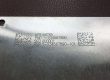
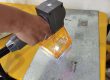
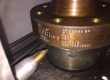
These are real marks from our sample room. The third photo is a failed CO2 test: too much heat, and the edges flaked off. More power does not give more contrast on glass. It gives more chips.
If you do use CO2 on glass, lower the power and raise the speed. Engravers also lay damp paper on the glass to cut chipping.
The surest test is your own bottle. Send us two or three of your bottles and we will mark them with UV and CO2, then send back photos and a video.
Painted bottles surprise people. On a sprayed spirit bottle, the laser does not frost the glass under the paint. It removes the paint, so the mark is clear glass showing through the colour. That is often the look a premium brand wants.

Fiber lasers are a poor fit for clear glass, because the beam passes straight through. They can still remove paint from a coated bottle. Our guide to laser marking glass covers each glass type, tempered glass and whether a mark weakens the wall.
Can you engrave round, tapered and flat bottles?
Yes. Round bottles turn in a rotary axis; HeatSign fits a D80 chuck as standard, with D100 and D125 for larger bottles. Tapered shoulders need a tilting rotary axis or dynamic focus. Flat perfume bottles sit on the table in a simple jig.
Bottle shape | How it is held | What to check |
|---|---|---|
Round, straight body (wine, spirits, most beer) | Rotary axis with a chuck (D80 standard, D100 or D125 for larger bottles) | Body diameter. Depending on the chuck, our rotary axes clamp parts from 4 mm up to 200 mm (0.16–7.9 in). |
Tapered shoulder or neck | Rotary axis tilted (up to 90°), or a dynamic-focus head | How steep the taper is across the mark |
Flat or oval perfume bottle | Flat table with a jig | That each face sits at the same height |
Very tall or heavy bottle | Rotary axis plus a tail support | Bottle length and weight |

The chuck holds the bottle like a drill holds a bit, and the motor turns it under the beam. The laser marks a narrow strip at a time, so the text wraps around the bottle without stretching. Rotary axis vs dynamic focus explains when each one is the better choice for curved glass.
Video: a desktop UV laser engraving logos on glass perfume bottles.
Measure before you order. Send the supplier the body diameter, the length and a photo of the shoulder. A bottle that does not fit the chuck is the most avoidable problem in this whole purchase.
Where on the bottle should the mark go?
Put brand marks and names on the front or shoulder, where buyers look. Put lot codes and Data Matrix codes on the heel, base or label. On returnable bottles, put the date and lot code on the label or neck collar, not the glass, so old marks do not pile up.
Where | Best for |
|---|---|
Front of the body | Names, messages, gift engraving |
Shoulder | Brand logo that replaces a printed decoration |
Heel or base | Lot code, Data Matrix code, anti-counterfeit mark the buyer does not see |
Label, neck collar or cap | Date and lot codes on returnable bottles |

Returnable bottles go round many times: filled, sold, collected, washed, filled again. A permanent date code on the glass would still be there on the next trip, next to the new one. So permanent laser marks suit things that never change, like the brand or the bottle ID.
Spanish brewer Damm shows the usual fix. On its returnable-bottle line, lasers print the lot code and best-before date on the labels and neck collars, at about 60,000 bottles an hour, according to Food Processing. Some lines use a washable ink on the glass instead.
Can you engrave a bottle that is already filled?
Often yes, with care. Still spirits, wine and syrups usually mark fine with a low-heat UV setting. Sparkling wine, beer and other bottles under pressure carry the highest risk under CO2 heat. Test filled samples first, or mark the bottles before filling.
Engravers disagree on this, and both sides have a point. One Sawmill Creek forum thread shows both sides. One engraver writes: “Absolutely do not, under any circumstances, laser full bottles of wine, beer or whiskey.” Another replies that he “just finished laser engraving full bottles of Maple syrup, and had no problems.”
How we read the risk
- Still liquid, UV, light mark: low risk. This is how most shops engrave a gift bottle the customer brings in.
- Still liquid, CO2, deep mark: medium risk. The heat stress stays in the surface.
- Bottle under pressure, any deep mark: high risk. Mark empty bottles, or mark the label or cap.
On a filling line, the choice is usually made for you. Mark empty bottles before the filler, or mark the label, cap or neck collar after it.
What does bottle engraving cost per bottle, and when does the machine pay back?
Laser marking uses no ink or labels, so the cost per bottle is mostly labour and power. Shops charge about $20–45 to engrave a bottle. At $20 a bottle, a $4,500 UV machine covers its price after about 225 bottles, before labour.
Machine | Price | Running cost per bottle |
|---|---|---|
Desktop UV laser marker + rotary axis | $3,000–5,900 | No ink or labels. Mainly operator time. |
Desktop CO2 laser marking machine | $3,000–6,500 | No ink or labels. RF metal tube rated about 20,000 hours. |
Flying CO2 or UV laser coder | $3,800–9,000 | No ink, solvent or ribbons. Mainly power. |
Do the personalization maths yourself
Machine price ÷ price you charge per bottle = bottles to cover the machine
Example: $4,500 ÷ $20 = 225 bottles. At 40 bottles an hour, labour at $20 an hour adds about $0.50 a bottle.
The $20 figure is a public retail price, not ours. One liquor store charges $20 to engrave a bottle. An engraver on the Sawmill Creek forum quotes $25–45 for single orders, with a $45 minimum for round items. Your own price depends on your market.
Want the numbers for your own bottle? Tell us your bottles per day and the mark size, and we will quote the machine with a cycle time for your job.
On a line, the comparison is with inkjet. A laser coder has no ink, solvent or printhead cleaning. Our laser coding machine guide works through the yearly cost of laser vs inkjet line by line.
Are there rules for engraving or coding bottles?
Yes. In the US, 27 CFR 5.44 lets retailers and distillers engrave a name or other identifying text on spirits bottles without new label approval. The text must not describe the spirit or cover the label. In the EU, packaged drinks need a lot code.
United States: personalized spirits bottles
- Text that identifies the buyer, the retailer or the wholesaler can be added by engraving, stickers or stencils (27 CFR 5.44).
- It can be added before or after the bottle leaves the distillery.
- It must not describe the spirit and must not cover any label.
- Changes to approved label text follow TTB’s personalized labels guidance.
European Union: lot codes
- Packaged food and drink must carry a lot code (Directive 2011/91/EU).
- The lot code usually starts with the letter “L”.
- Packs whose largest side is under 10 cm² (1.6 in²) are exempt.
- The producer or packer sets the lot.
Local rules can add more, so check with your regulator or label approver. For a gift shop, the practical rule is simple: engrave the person, not the product. “Happy 40th, Maria” is fine. “Aged 12 years” belongs on the approved label.
One EHS point for shops: an open UV or CO2 laser marker is a Class 4 laser. The operator needs safety glasses rated for that wavelength, and a public counter needs an enclosure around the beam.
What should you send a supplier before you buy?
Send about ten real bottles, filled or empty as they will be in production, plus the artwork, mark size, bottles per hour and whether the glass is coated. A supplier should send back marked samples and a video before quoting.
- Real bottles. About ten, in the state you will mark them: empty, filled, labelled or coated.
- Glass type and wall thickness. Your bottle maker can tell you. Under 2 mm points to UV.
- Coating. Say if the bottle is sprayed, painted or frosted. It changes the settings completely.
- Size and shape. Body diameter, length, and a photo of the shoulder for tapered bottles.
- Artwork and mark size. A file, and where on the bottle it goes.
- Volume. Bottles per hour or per day, and whether the bottle stops or moves.
- Line signals. For a line coder: your conveyor speed and how your controller starts and stops a mark.
HeatSign marks a similar bottle on the matching machine and sends you a short video of the result, with the right power, options and one clear price. If you cannot ship bottles, a photo with the diameter and wall thickness is enough to start.
Glass bottle engraving machine FAQ
What machine do I need to engrave glass bottles?
For names and logos on a few hundred bottles a day, a desktop UV laser marker with a rotary axis. For date and lot codes on a filling line, a flying CO2 or UV laser coder synced to the conveyor.
How much does a glass bottle engraving machine cost?
HeatSign desktop UV laser markers cost $3,000–5,900, desktop CO2 machines $3,000–6,500, and flying laser coders for production lines $3,800–9,000. A rotary axis is needed for round bottles.
How do you laser engrave a glass bottle?
Clamp the bottle in a rotary axis, set the focus on the glass surface, load the artwork and mark. On a 5 W UV laser, a 40 × 15 mm name takes about one minute. Test on a spare bottle first.
Can a fiber laser engrave glass bottles?
Not clear glass. The 1,064 nm beam passes through it. A fiber laser can remove paint or coating from a coated bottle. For bare glass, use UV or CO2. See can a fiber laser engrave glass.
Can you engrave perfume bottles?
Yes. Use a UV laser, because most perfume bottles have walls under 2 mm and CO2 heat can crack them. Flat bottles sit on the table in a jig; round ones go in a rotary axis.
How much does it cost to get a bottle engraved?
Shops charge about $20–45 per bottle. One liquor store charges $20; an engraver on a trade forum quotes $25–45, with a higher minimum for round items.
Does laser engraving weaken a glass bottle?
CO2 heat can leave tiny cracks in the surface, which matters on thin or pressurised bottles. UV marks with little heat, so the wall keeps its strength. Our glass marking guide explains why.
The most common mistake we see is buying the right laser for the wrong job. A fast line coder ends up on a gift counter, or a desktop UV marker faces a line that runs 10,000 bottles an hour.
So decide first whether your bottles stop or move. Then pick UV or CO2 by the glass, and check the rotary axis against your bottle.
If you already know your bottle, your mark and your volume, send them to us. We will reply with one machine, a marked sample video and a price.
Sources
- eCFR, 27 CFR 5.44 — Information that may be added to containers (via Cornell LII)
- TTB, Public Guidance: Personalized Labels (TTB G 2017-2)
- Directive 2011/91/EU on indications or marks identifying the lot to which a foodstuff belongs
- Food Processing, “Giving a Damm about traceability” (returnable-bottle line, labels and neck collars)
- Linx, CSL60 laser coder product page; Domino, Dx1060i launch news (Labels & Labeling); Macsa, SPA2 product page — maker speed ratings, no links
- US Patent 6,697,408 and 7,058,093 — CO2 pulses and microcracks on stressed glass (inventor claims)
- Sawmill Creek forum, “Laser etching full glass bottles” and “Cost to etch a bottle”
- Liquor Barn, bottle engraving service page
- HeatSign sample room: 5 W UV laser marker, 75 mm bottle, 40 × 15 mm mark